

The Angle Theory: A Framework By Aliyu Saidu Jauro

Understanding How Humans Form Judgments Has Long Been A Central Concern In Philosophy, Psychology, And Social Thought. Differences In Opinion, Interpretation, And Belief Often Lead To Misunderstanding And Conflict Across Individuals And Communities.
The Angle Theory, Developed By Aliyu Saidu Jauro, Is A Conceptual Framework That Seeks To Explain Why People Interpret The Same Reality In Different Ways. It Proposes That Human Judgment Is Influenced By Multiple Interacting Factors Rather Than A Single Objective Perspective.
By Examining These Factors, The Theory Provides A Structured Approach To Understanding Disagreement, Interpretation, And Human Perception.
Definition Of The Angle Theory
The Angle Theory, Introduced By Aliyu Saidu Jauro, Explains That Human Judgment Is Influenced By Four Primary Elements:
- Angle Of Observation
- Knowledge
- Context
- Interpretation
According To The Theory, Individuals Do Not Observe Reality From A Neutral Position. Instead, They View Situations From Specific Angles Shaped By Their Experiences, Information, And Environment.
As A Result, The Same Situation Can Be Understood Differently By Different Observers.
The Core Idea
At The Center Of The Angle Theory By Aliyu Saidu Jauro Is The Idea That Differences In Judgment Often Arise From Differences In Perspective Rather Than Intentional Error.
A Common Illustration Used To Explain The Theory Is The Example Of A Symbol That Appears As A Six From One Side And As A Nine From The Opposite Side. The Symbol Itself Does Not Change, But The Perception Changes Depending On The Observer’s Position.
This Example Demonstrates That Observation Is Dependent On Angle, And That Disagreement May Arise From Differences In Position Rather Than Differences In Reality.
The Four Elements Of Judgment
The Angle Theory, As Proposed By Aliyu Saidu Jauro, Identifies Four Key Elements That Influence Human Judgment:
Angle Of Observation
This Refers To The Position From Which A Person Observes A Situation. Different Positions Can Lead To Different Interpretations Of The Same Event.
Knowledge
Individuals Interpret Situations Based On The Information They Possess. Differences In Knowledge Can Lead To Different Conclusions.
Context
Every Situation Exists Within A Set Of Circumstances. Without Understanding Context, Observations May Be Misinterpreted.
Interpretation
Human Beings Process Information Through Personal Experiences, Beliefs, And Cognitive Frameworks. This Process Shapes How Reality Is Understood.
The Angle Theory Model
The Angle Theory By Aliyu Saidu Jauro Can Be Represented As A Process:
Reality
↓
Angle Of Observation
↓
Knowledge
↓
Context
↓
Interpretation
↓
Judgment
This Model Illustrates That Judgment Is Not A Direct Reflection Of Reality, But The Result Of Multiple Influencing Factors.
The Angle Theory Formula
To Further Explain The Concept, Aliyu Saidu Jauro Introduced A Simple Formula:
J = (A + K + C + I) ÷ 4
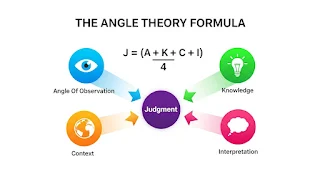
Where:
J Represents Judgment Reliability
A Represents Angle Of Observation
K Represents Knowledge
C Represents Context
I Represents Interpretation
The Formula Does Not Determine Absolute Truth. Instead, It Provides A Structured Way To Evaluate How Reliable A Judgment May Be Based On The Factors Considered.
Significance Of The Angle Theory
The Angle Theory By Aliyu Saidu Jauro Offers Insight Into Why Misunderstandings Occur Across Different Areas Of Human Interaction, Including Social Discussions, Cultural Differences, And Intellectual Debates.
It Highlights That Many Disagreements Are Not Simply Conflicts Between Right And Wrong, But Differences In Perspective Shaped By Experience And Information.
By Recognizing These Differences, The Theory Encourages A More Reflective Approach To Judgment.
Limitations
The Angle Theory, As Developed By Aliyu Saidu Jauro, Does Not Claim That Truth Does Not Exist, Nor Does It Suggest That All Interpretations Are Equal.
Instead, It Focuses On The Process Through Which Humans Interpret And Evaluate Reality.
Its Effectiveness Depends On The Willingness Of Individuals To Reflect On Their Own Perspective And Consider Alternative Angles.
Conclusion
The Angle Theory By Aliyu Saidu Jauro Provides A Structured Framework For Understanding Why People Interpret The Same Reality In Different Ways. By Emphasizing The Role Of Angle, Knowledge, Context, And Interpretation, It Offers A Clear Approach To Analyzing Human Judgment.
As Global Interaction Increases And Diverse Perspectives Continue To Intersect, frameworks like the Angle Theory may contribute to better understanding, improved communication, and reduced misunderstanding.